


Farming Guides
Growing Cannabis on Terrace and Balcony: Complete Guide 2026
May
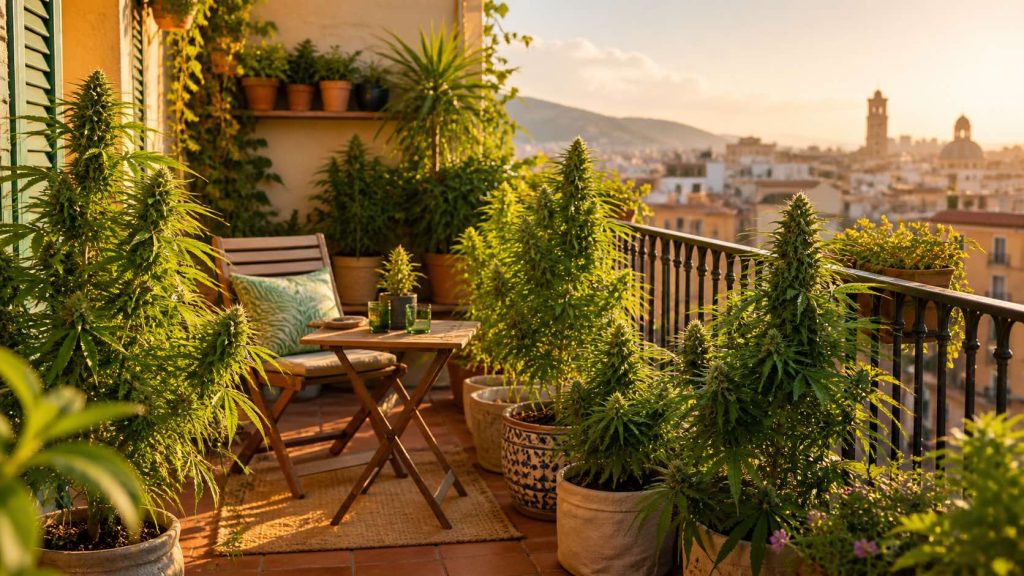
For many urban growers, having a terrace or balcony is the only way to access real sunlight. And real sunlight —especially in Spain— remains the most powerful, free and spectrally complete source of light there is. Used to its full potential, a south-facing balcony can produce buds of a quality that surprises those used to growing indoors.
But growing plants at height has its own set of rules. The wind, visibility, the heat from the pot in summer, privacy from neighbours and watering management are all completely different from growing in a garden or outdoors. This guide has been written specifically for this environment: flat terraces, city balconies and rooftops.
→ This guide is part of our Complete Guide to Growing Cannabis from Seed.
Table of contents
- Real advantages and limitations
- Orientation and hours of sunshine: the first thing to work out
- Plant pots: size, material and drainage
- Watering on the terrace: the summer challenge
- Wind and privacy
- Growing calendar for balconies in Spain
- Which varieties to choose
- Most common mistakes
The real advantages and limitations of terrace farming
Before you get started, it’s a good idea to have realistic expectations. Growing on a terrace is neither the paradise of the great outdoors nor the nightmare that some people describe. It’s an environment with its own distinct advantages and specific limitations.
What works in your favour
- Free, full-spectrum sunlight. The Mediterranean sun from May to September provides between 800 and 1,200 µmol/m²/s at peak times, more than any LED on the market. At no energy cost.
- Access control. Unlike the garden, the terrace is yours. You can decide who comes in and when.
- Plant mobility. The plant pots can be moved if the weather changes, if there is an unwelcome visitor, or if you need to adjust the amount of sunlight they receive.
- Fast cycles with automatic machines. In Spain, between April and September, you can grow two full crops of autoflowers in the same season.
What complicates matters
- Space and weight. Floor slabs have load limits. Large plant pots filled with damp soil are very heavy. You need to bear this in mind before growing plants vertically.
- Extreme heat in summer. Pots on a terrace can reach soil temperatures of 40–50 °C in August if they are dark in colour and exposed to direct sunlight. This destroys the roots.
- More frequent watering. The sun and wind cause the growing medium to dry out much more quickly than in a garden. In summer, it may be necessary to water twice a day.
- Urban photoperiod. Light pollution in cities can interfere with the period of darkness required for photoperiodic feminised strains to flower. Autoflowers do not have this problem.
- Appearance and smell. The scent during flowering is intense and lingers. In a block of flats, it needs to be managed sensibly.
Orientation and hours of sunshine: the first thing to work out
Not all terraces are equally suitable for growing crops. Aspect is the most critical factor – and the only one you cannot change.
| Guidance | Hours of sunshine (summer) | Assessment for cultivation |
|---|---|---|
| South | 8–10 consecutive hours | Optimal. The best possible scenario. |
| South-east / South-west | 6–8 hours straight | Very good. Excellent results. |
| This | 4–6 hours (morning) | Acceptable. Autoflowers are better than feminised strains. |
| West | 4–6 hours (afternoon) | Acceptable. The afternoon sun is warmer and can be quite hot in August. |
| North | 0–2 hours or none | Not recommended for cannabis without supplementary artificial light. |
If your balcony faces east or west, don’t rule out growing: with short-cycle autoflowers and hardy strains, you can achieve decent results. But you’ll need to be more careful when choosing a strain and managing your yield expectations.
The sun test: Before planting, go out onto the terrace at 10 am, 1 pm and 5 pm for a week and make a note of where the sun shines directly and for how long. Many terraces have overhangs, walls or nearby buildings that cast shade at key times of the day.
Plant pots: size, material and drainage
On a balcony, a pot is the equivalent of the soil in a garden. Its size directly limits the size and yield of the plant. There are no shortcuts: a plant in a small pot will produce little, regardless of its genetics or how much sun it receives.
Recommended sizes by seed type
| Seed type | Minimum size | Optimal size | Why |
|---|---|---|---|
| Automatic | 11 L | 15–20 L | Short growing cycle, compact root system. Large pots yield disproportionately high harvests here. |
| Feminised Indica | 20 L | 25–30 L | Longer vegetative phase; it needs space to develop its roots and structure. |
| Fast Version | 20 L | 25 L | Similar to a photo-period plant but with a faster flowering cycle: the root needs to become well-established before flowering begins. |
Pot material: heat is the enemy
On a terrace in summer, the material the pot is made of matters more than in any other setting:
- Black plastic plant pots: The most common and cheapest options. The problem is that they absorb the sun’s heat and cause the temperature of the growing medium to rise to dangerous levels. In August, a black plant pot in the sun can reach temperatures of over 45 °C inside. Solution: paint them white, wrap them in jute fabric or fit a reflective cover.
- White or light-coloured plant pots: They reflect the heat. Much better for a terrace in summer. If you’re only going to change one thing, make it the colour of the pot.
- Air pots (fabric plant pots): The best option in terms of radical aeration and temperature. The fabric is breathable, regulates the temperature of the growing medium and encourages root pruning. The downside is that they dry out more quickly and require more frequent watering.
- Terracotta: It’s breathable and helps regulate your body temperature. But it’s quite heavy — check your balcony’s weight limit before using too many of them.
Drainage: compulsory, not optional
Every pot on a terrace needs drainage holes and a saucer underneath that you can empty. Overwatering a pot without drainage will suffocate the roots within days. Check that the holes aren’t blocked before planting and empty the saucer after each watering.
Watering on the terrace: the summer challenge
The soil on a terrace dries out much faster than in a garden. Direct sunlight, wind and the high temperatures of the Mediterranean summer can cause a 20-litre pot to go from damp to completely dry in less than 24 hours in the middle of August.
Watering frequency by season
| Month | Average temperature | Estimated watering frequency |
|---|---|---|
| April–May | 15–22 °C | Every 2–3 days |
| June | 22–28 °C | Every 1–2 days |
| July–August | 28–36 °C | Once or twice a day. Preferably during the cooler parts of the day (early morning and late afternoon). |
| September | 20–27 °C | Every 1–2 days |
| October | 14–20 °C | Every 2–3 days. Reduce the frequency when the rains come. |
Always water early in the morning or at dusk. Watering during the hottest part of the day causes the water to evaporate before it reaches the roots, can cause burns on wet leaves and puts the plant under unnecessary stress.
Automating watering: the most practical solution
If you have more than two plants or if you’re going away during the summer, a drip irrigation timer is the best value-for-money investment you can make. Basic drip irrigation systems with a timer cost between €30 and €80 and eliminate the biggest risk of growing plants on a balcony: water stress caused by a lack of water.
Set the timer to water at dawn and, if necessary, at dusk. Check the moisture level of the growing medium manually for the first few days to adjust the amount of water per cycle.
Wind and privacy
The wind: friend and foe
A gentle breeze is good: it moves the stem, strengthens it and improves air circulation amongst the branches, reducing the risk of fungal diseases. But the strong, constant wind on high terraces is a serious problem.
The effects of excessive wind on cannabis:
- The growing medium dries out quickly (water more often).
- Mechanical damage to branches during flowering, when the buds are heavy.
- Constant stress that slows growth and reduces production.
- On very exposed terraces, it can «scorch» the edges of the leaves.
Practical solutions:
- Shade nets or insect screens fitted to the railing act as windbreaks and reduce wind speed by 40–60 % without blocking out the light.
- Place the plants in the most sheltered corner of the terrace, using the wall as a natural barrier.
- Bamboo stakes and Velcro straps to secure flowering branches. On a windy terrace, this is essential.
- Lightweight plastic plant pots can tip over in strong winds. If you’re using lightweight pots, place something heavy on the saucer or secure the pot to the railing.
Privacy: the factor that many overlook until it’s too late
Cannabis plants in flower smell. A lot. And they grow: a photoperiodic feminised plant in a 25-litre pot can easily exceed one and a half metres. Both factors can cause friction with neighbours and attract unwanted attention.
Smart privacy management:
- Choose compact strains. Indica and autoflowering strains rarely grow taller than one metre. A discreet plant is always better than a high-yielding one that can be seen from three storeys up.
- Use the vegetation as a screen. Tall ornamental plants (bamboo, lavender, climbing roses) in front of the cannabis plants create a natural visual barrier.
- For the smell: There is no perfect solution when growing outdoors, but planting away from neighbours’ windows and avoiding times when there are lots of people about reduces exposure. Some strains are more pungent than others — Indica strains tend to be more discreet than Sativa strains.
Terrace growing calendar for Spain
Spain has an exceptionally long outdoor growing season compared with the rest of Europe. In the Mediterranean region and in the south, it is possible to start planting as early as March, using indoor germination, and to harvest as late as November.
| Month | Automatic | Feminised / Fast Version |
|---|---|---|
| February–March | Germinate indoors under artificial light. Transplant to the terrace once there is no risk of frost (southern and eastern regions). | Too early for outdoors. Germinate indoors. |
| April | First planting on the terrace. With 14+ hours of daylight, the autoflowers get off to a good start. The first harvest is possible in late June. | Planting on a terrace. Vegetative phase with long spring days. |
| May–June | Second sowing. A second harvest is possible in August–September. | Full growth. Apply training techniques (LST) if space permits. |
| July–August | A third sowing may be possible in warm areas. Intensive irrigation management. | The days are starting to get shorter. Feminised plants naturally begin to enter the pre-flowering stage from August onwards. |
| September | Harvest from the second or third planting. Cooler nights enhance the terpenes. | In full bloom. Keep an eye on humidity and the risk of botrytis due to the cool night-time temperatures. |
| October–November | The latest possible harvest in areas without early frosts. | Harvest. Fast Version before mid-October; classic feminised strains until November in the south. |
→ For more details on the best times by geographical area, see our the outdoor growing section in the comprehensive guide.
Which varieties to choose for patios and balconies
Not all strains perform equally well on a balcony. The key is to prioritise three characteristics: a compact growth habit, resistance to heat and fluctuations in humidity, and a manageable aromatic profile during flowering.
Automatic: the smartest choice for a terrace
For most urban growers, autoflowering strains are the answer. Their photoperiod-independent growth cycle eliminates the problem of urban light pollution, their compact size makes them discreet, and their rapid growth allows growers to make the most of the growing season.
- Apple Bananas Auto — Compact, aromatic and with an exceptional flavour profile. 70–75 days in total, growing to 60–80 cm. Ideal for anyone who wants dispensary-grade quality in a 15-litre pot on their balcony.
- Autoflowering Indica strains from 00 Seeds — The bank has been selecting trees based on their compact structure and high density for decades. View the full range of automatic machines →
Feminised strains for south-facing terraces
If your terrace gets 6+ hours of direct sunlight and you have space for a plant that’s one and a half metres tall, short-cycle photoperiod feminised strains are a very viable option. They produce much more per plant than autoflowering strains, provided you have the space.
- Gorilla Glue — A sturdy plant that withstands the wind well. High resin yield. Flowering period of 65–70 days; harvest before the October rains arrive in the Mediterranean.
- Feminised Indica strains from 00 Seeds — The Indica growth habit (wider than it is tall) is ideal for balconies: less height, more buds per plant. View the full catalogue →
Fast Version: the best balance between output and speed
For outdoor growing in areas where autumn arrives early (northern Spain, high-altitude inland regions), the Fast Version strains are the solution. They reduce the flowering time by 1–3 weeks compared to the standard feminised strain, meaning you can harvest in September rather than October and avoid the rain and cold that ruin the outer buds.
- Blue Dream Fast Version — A perfect balance between Sativa and Indica, a fruity flavour and a flowering time of 55–60 days. It copes well with the fluctuating temperatures of autumn.
→ Not sure which format to choose? Read our guide Autoflowering vs Feminised vs Fast: which one’s for you?
The most common mistakes in terrace gardening
1. Using pots that are too small
It’s the most common mistake – and the easiest to avoid. A feminised plant in an 11-litre pot will yield only a fraction of what it would in a 25-litre pot, regardless of how much sun it gets or how well you look after its nutrition. The roots are the driving force: give them space.
2. Ignore the heat from the plant pot in August
Cannabis roots die when the substrate temperature exceeds 30 °C. A black pot in the midday sun in August can exceed 45 °C. This is not just a theoretical risk: it is the most common reason why plants «stop growing» for no apparent reason in July and August. Protect the pots from direct sunlight at the base, or use light-coloured pots.
3. Water during the hottest part of the day
Water on the surface of the leaves acts as a magnifying glass in direct sunlight and causes burns. Watering at midday also causes the water to evaporate before it reaches the roots. Always water before 10 am or after 7 pm.
4. Do not train the branches before flowering
During flowering, the buds become heavy. A gust of wind can bend or break a heavily laden branch that has not been staked. Put the stakes in place during the late growth stage, before the buds start to swell.
5. Using photoperiod feminised strains on terraces with light pollution
If your balcony is exposed to light from street lamps, shop windows or illuminated signs at night, photoperiod feminised strains will be unable to achieve the darkness required to enter the flowering stage. The result: plants that remain in the vegetative stage indefinitely or revert to the vegetative stage during flowering. Use autoflowering strains in urban environments with night-time light.
Conclusion: the terrace is a natural grow room — treat it as such
Growing on a terrace is not simply a simplified form of outdoor growing. It has its own variables — pot heat, watering frequency, wind, privacy, light pollution — which must be managed sensibly. But when done right, a south-facing terrace in Spain produces buds of surprising quality, with zero energy costs and the satisfaction of having made the most of Europe’s best climate.
The key is to choose the right strain for your growing conditions and space, not to skimp on the size of the pot, and to manage the summer heat before it becomes a problem.
→ Return to the Complete Cultivation Guide to see the rest of the process, from germination to harvest.
→ Find the perfect variety for your terrace at the 00 Seeds catalogue.
How many hours of direct sunlight does your terrace get, and which way does it face? Let us know in the comments and we’ll recommend the option that best suits your specific situation.
